The Rhythm is Going to Get You
By Paul Michael Peters
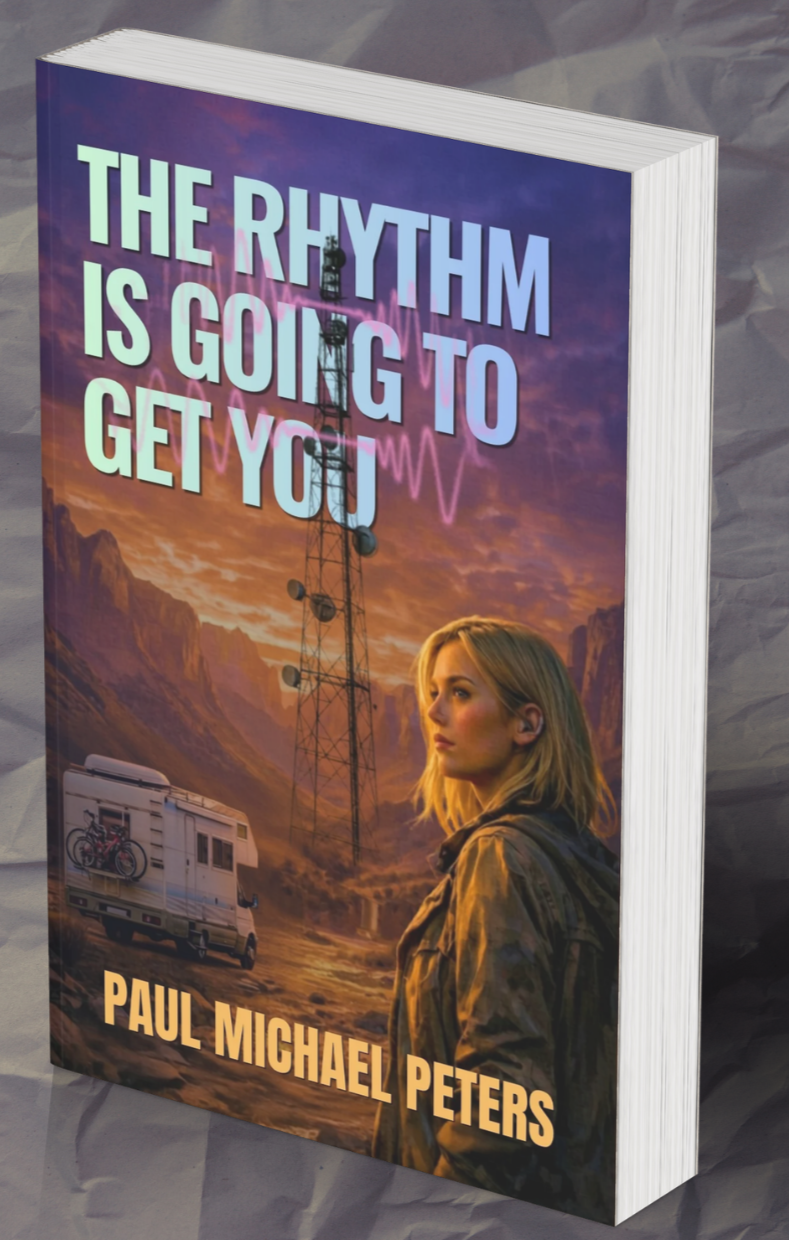
The Rhythm is Going to Get You
Publisher: Owl Club Media Group
ASIN: B0GPM8JVSC
ISBN eBook: 979-8-9912595-8-3
ISBN Paperback: 979-8-9912595-9-0
ISBN Hardcover: 979-8-9940144-0-0
Print length: 140 pages
Science Fiction
Apocalyptic & Post-Apocalyptic
Science Fiction Romance
Dystopian
Van Life
Survivalist
KEY DESCRIPTORS
deaf protagonist fiction
post apocalyptic love story
van life novel
survival fiction desert
quiet apocalypse literary fiction
sound music horror mind control
disability representation speculative fiction
The Rhythm Is Going to Get You is a quiet-apocalypse sci-fi thriller and end-of-world love story about Charlie, a deaf van-lifer who finds Valhalla, a hidden canyon of perfect silence. Paradise fit in a van; the apocalypse fit in eight bars.
Coming to you September 15, 2026 Release
If you want release updates, early pricing, and first access, I've set up a separate list just for this book:
THE RHYTHM IS GOING TO GET YOU is post-apocalyptic literary fiction. It will appeal to readers of Peter Heller's The Dog Stars and Ling Ma's Severance, the haunted beauty of Station Eleven, with the sensory-threat horror of Bird Box. When a sound-based contagion turns listeners into mindless followers, a deaf van-lifer discovers his silence is the only immunity—and must decide how far he'll go to pull the woman he loves into his world.
ABOUT THE STORY
The thing that made him invisible made him invincible.
Charlie is deaf. Has been his whole life. He lives in a converted van in the Arizona desert, picking up gig work, dodging dusty loners, and trying to figure out what comes after a college degree that opened exactly zero doors.
Then he finds Valhalla — a hidden canyon with water, shade, and a silence so complete it feels like the earth is keeping a secret. And he finds Anna — a British van-life influencer with fading hearing and a smile that changes everything.
Then the world ends. Not with bombs. Not with plague. With a song. A frequency that shouldn't exist hides inside an '80s pop song and spreads across every radio, every speaker, every signal. Anyone who hears it is taken. Millions surrender to the rhythm — walking until their shoes disintegrate, standing in diners staring at nothing, chasing anyone still free.
Charlie can't hear it. That's the only reason he's still human. But Anna can.
The Rhythm Is Going to Get You is a post-apocalyptic science fiction romance about what you'd sacrifice for the person you love.
For readers who loved the haunted beauty of Station Eleven, the sensory terror of Bird Box, and the slow unraveling of The Age of Miracles — told through a voice you've never heard in post-apocalyptic fiction.
Archer's Voice meets Dust in a van-life apocalypse where silence is survival.
Project Hail Mary's science obsession meets Radio Silence in a desert where the wrong song kills you.
Wool's contained dread meets Mira Grant's Parasite — but the only safe place is a deaf man's van.
Apparitions meets Archer's Voice in a sound-plague Southwest where deafness is the last immunity.
More Than Survival's slow burn meets Dust — two people finding each other in the last quiet place on earth.
Archer's Voice meets The Road, with a parasite that spreads through rhythm.
The Rhythm is Going to Get You
By Paul Michael Peters
CHAPTER 1
The Pied Piper
Paradise fit in a van; the apocalypse fit in eight bars. I found heaven on earth and went through hell before the song finished playing. Silence saved me. The rhythm took everyone else. Five months between sunrise and ruin.
People will tell you college graduation's the start of life’s big adventure, but that’s not how the world works anymore.
I couldn’t find a job. I couldn’t afford my own place. Rent was nuts. And it seemed like things just weren’t going my way. So I did what so many of my peers did. I bought myself a cheap-ass van and converted it into a home. It took all my savings and three months in my parents’ driveway, but I got it done. Pretty proud of myself, too.
Going in, I knew nothing about tools or electricity, and just enough about changing the oil on the 2007 GM 6.6L Duramax V8 to keep it running. It’s funny how much you learn by throwing yourself completely into something. I’m told that’s true for language, but what would I know about that?
Ninety days. Nearly lost a finger — twice. Lots of rough edges, but all covered in paint. I named her Mrs. Driscoll, because she always demanded to be treated like a lady. Like a seventh grade teacher, she had to be patient, and put up with a lot of crap. So much kitty litter and spilled oil that my father basically chased me off the drive near the end.
Dad. I miss him. I miss Mom. But that—boy, that was in August. They were good parents. Too good for me. I needed more space, more independence, less hovering. Even when I was commuting to college and still living in the basement, I could feel the reach of their tentacles touching everything I did. Charlie, do this. Charlie, do that. Charlie, did you... So I had to go. It feels like forever ago. Before it all changed.
In August, I headed out on my big adventure. Both tanks were full of diesel. I had added an extra tank during the build for long drives, and as a dual-purpose setup, I could use it for heat when the nights turned bitter. Long-range and built for any climate, Mrs. Driscoll and I were ready for anything.
And boy, was I glad I’d planned it that way. By September, things turned chilly. You don’t think of the desert as cold, but it is. Damn cold. The kind that slips through your layers, finds every seam, and settles deep in your bones until you regret ever leaving home, ever daring to call this an adventure. Especially at night. Alone at night. Those clear skies, where you can see every star in the Milky Way, were beautiful, but there was nothing to hold in the warmth of the desert floor. Just you and the universe. Nothing else. It’s easy to feel small and cold. But every miserable, freezing inch of it belonged to me.
For fifteen dollars, one hour pay from a programming gig, you can get a year pass from the Arizona State Trust Land and Bureau of Land Management. Anywhere outside Phoenix, where the city isn’t rushing out to build new retirement communities, you’ll find camping.
You read about these van-life communities online, catch the closed captions on influencer videos, and it all looks fun. Big community. Great people. Freedom to do most anything — mountain biking, fishing, soaking in natural hot springs, laughter and joy across the land. But that’s not what I found.
It must take forever to get those twenty minutes of footage the algorithms eat up. I'd spend weeks out there in the van, picking up gigs to pay for the Starlink and groceries, and only run into some dusty loner with a big beard giving me dirty looks.
Sure, on occasion, there was that world you’re introduced to — the kite guy was first. It was easy to spot him in the valley with the two lines tethered to the ladder on his back door, reaching up into the blue yonder. One was a Chinese dragon kite, red and yellow, riding the updrafts, tail whipping in the wind, watching over all. The other, twice the length at least, was a neon green millipede crawling across the sky at the whims of directional winds that sent it running back and forth in a playful race. Moiz — he introduced himself to me after two hours of watching him — would sit on the roof of his box truck to pass the days. He didn’t talk much, so I watched the videos he made online that covered the history and importance of kites, how to build them, and the discovery of mixed materials and chemicals that let them linger aloft a little longer. He would talk about kites and winds. The burning bliss of the string first catching the right draft where they would fly for hours. Halfway through the week, he said his goodbyes to pack up and fly. His 14-day limit on camping at this spot had expired; he was moving on to the next stop on his map to follow his bliss.
Moiz was the dream, Moiz was van life as I pictured it. But then I met Radio Guy. It was pure intrigue and fascination finding him. A glint of sun bounced off this metal monstrosity in the middle of a canyon. On inspection, I found the reflection was from his radio tower. He had parked his rig at the bottom of a dried riverbed, and on each side, fastened and staked six different tower tension lines to the raised riverbanks that looked like cliffs.
From the river’s bank, looking down, I watched the van rock back and forth, so I knew he was in there. On approach, the van rocked more. I stood a safe distance away, like fifteen feet. His side door opened, and the big man bumbled out, thick beard waggling, arms waving, and feet stamping.
“What, are you deaf or something?” I finally understood him. “Didn't hear the alarm? Didn't believe the warning message?”
“No,” I replied, and handed him my card.
Slow to step forward, timid in touch, he took the laminated card and read it.
“Well, shit,” he huffed. “Didn't think of that scenario.”
I had to earn his trust like he might be a wild dog. Slow, no quick movements, treats in pocket with rewards at the ready.
Radio Guy seemed to be one of those people who talked loudly. At least around me. Maybe he thought it would help me understand, but no. Shouting at a deaf man is a waste of energy, I assure you. He loved what he did. Didn't care about being a hermit. Didn't care how he smelled or looked. “Spent too much time in life trying to impress the ladies. Broken heart one too many times to care anymore. Just me, the radio, and the world.”
He explained how world band radio bounced off the ionosphere to pick up stations from around the world. London, All India, KBS Korea, the Voice of Turkey — he could hear them all. He was a global tourist without having to leave the comfort and safety of his van. Yes, he had AM and FM — “mostly religion and radicals” is how he described it — but he also monitored the governments, VHF/UHF, police, fire, and air. NOAA — the weather — he always kept on in the background so he could drop the antenna and move the van in case it rained. He talked about his relationships, his friends, the connections he made with his ham radio all over the big blue marble. Good people in the same place as him.
“Government!” he must have said a dozen times each hour. I never understood what he was saying about the codes, between the static, the silence, the changes. Something was getting him excited about the governments. Not just ours, all of them. He kept pointing to his equipment like I should be hearing it too. He showed off his modified earbuds. Said they protected him from “Them.”
He was right. A big blue marble filled with interesting people. I was right. Go out into the world filled with new and interesting people to connect with. You might know that one day. A place filled with people and ideas.
What I discovered about van life is that you could stand out and attract others to make these connections. But when people want to be left alone, it's easy to stay away.
Those were the early days. I was just finding my way. Computer guy with a satellite link doing code and AI gigs.
When I met the Scottish Madman, Nick, things changed. He was the unit. Not just dusty, but dirt- and mud-caked from the road. I remember his face like the sun burned into my brain. Big red hair, matted in parts, untamed in others, head and face to match — face on fire with expression — but it was still hard to see his lips. His eyes were an intense blue, almost unnatural. Nick had flown from Scotland and dropped a V6 into a toy car — the kind rich parents buy their six-year-olds to scamper around the yard. Batteries removed, frame strengthened, Nevada license added — Nick was riding it, driving it, whatever. He was trying to make his way from Las Vegas to a place called Bisbee, Arizona, in honor of his family’s land of the same name in Renfrew. I didn’t catch everything. I couldn’t. But I got that much.
He would talk into his phone to dictate so I could read. He showed me maps. He talked a lot in the two days we spent together, but I don’t think I made good company. I was good at holding and lifting things to help with repairs. Most people find it hard to connect with someone completely deaf. He wanted someone to talk with, not talk to. I suppose I wasn’t much better than a cactus for him. But I was someone. Enough for those days while he fixed his ride.
He explained what he called Valhalla. Southbound out of Vegas, he'd found untouched backcountry. A valley with water, trees, shade, and beauty unlike anything he'd ever seen. Pristine. Untouched. “Aye, like the first time you hike Angel’s Canyon in Armenia… all scramble and strain, till you get to the turn, and you know, it opens up. You’ve got to travel the Silk Road at least once in your life. And if you ever wanted to get away from it all, Valhalla is the place.”
I liked Nick. I liked his manner. He was experienced, but not old. I liked that he knew how to do things. I trusted him for it. I took his point on the map and decided to go for it. After all, if a toy car could get there, why couldn’t the mighty Mrs. Driscoll? Why not try to find a Viking paradise?
Valhalla, the Norse great hall. The place where heroes slain in battle were received. A Viking poet once wrote, “A deaf man can fight and win.” A deaf man could enter the great hall. It might be the most respected thing a Viking could do. I once read that deaf people were excluded from most of human history’s greatest tragedies. They didn’t hear the Sirens’ call. Couldn’t be hypnotized. Never fell for the Pied Piper’s tune. I always thought it was just someone trying to make me feel better about what I’d lost to meningitis at the age of nine. It turns out they were preparing me for what I’d keep.